Modernizing operational awareness in enterprise backup infrastructure
Self-initiated human factors and operational UX exploration
Project overview
This self-initiated project explored how human factors principles could improve the operational experience of enterprise backup infrastructure software.
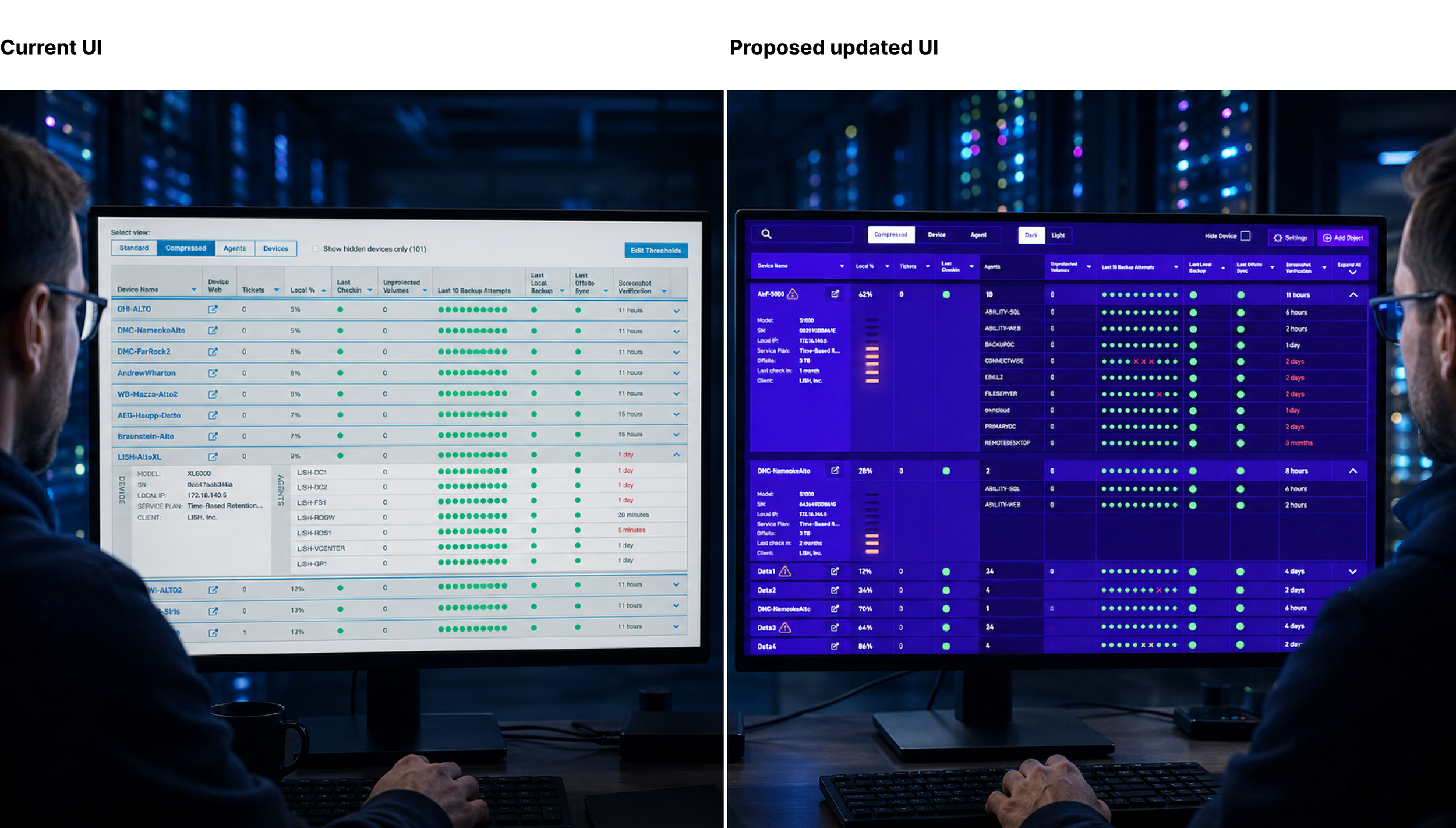
Most backup administration platforms evolved from legacy enterprise tooling patterns: dense tables, repetitive visual structures, weak hierarchy, and interfaces optimized for data exposure rather than human cognition. While technically functional, these systems often place a significant cognitive burden on operators responsible for monitoring large-scale infrastructure under time pressure.
The goal of this exploration was not simply visual modernization. The objective was to redesign the platform around how operators actually perceive, prioritize, and respond to operational system states in real-world monitoring environments.
The project focused on:
operational awareness
cognitive load reduction
anomaly detection
alarm fatigue mitigation
system trust
long-duration usability
The resulting concepts transformed the interface from a passive reporting tool into a more active operational awareness system.
Operational context
The platform was designed for enterprise backup administrators and infrastructure operations teams responsible for monitoring:
distributed backup jobs
storage utilization
replication integrity
restore readiness
SLA compliance
infrastructure failures
The interface would typically be used in:
enterprise IT environments
NOCs and infrastructure teams
overnight monitoring shifts
multi-monitor operational workstations
These environments often involve:
prolonged monitoring
multitasking across systems
frequent interruptions
low-light conditions
elevated stress during outages
Because backup failures may remain invisible until recovery is needed, operators must maintain vigilance despite long periods of nominal system behavior.
Problem
The original platform relied heavily on:
dense spreadsheet-style layouts
repetitive status indicators
text-dependent interpretation
weak prioritization of critical states
limited subsystem grouping
Operators were required to continuously perform:
serial row inspection
memory-based comparison
manual prioritization
repetitive verification behaviors
This interaction model increased:
cognitive load
vigilance fatigue
slower anomaly detection
alarm desensitization
risk of missed escalation conditions
The core challenge became:
How might a backup operations platform communicate system health in a way that reduces cognitive strain while improving operator responsiveness and confidence?
Human factors objectives
The redesign centered around several core human factors goals:
Improve operational awareness to allow operators to rapidly assess overall system health without reading every row individually.
Reduce cognitive load by decreasing dependence on working memory, conscious comparison, and repetitive scanning.
Improve anomaly detection by increasing visibility of degraded conditions through stronger hierarchy and preattentive signaling.
Reduce alarm fatigue by preventing nominal system states from competing visually with meaningful operational issues.
Improve system trust by creating an interface that communicates reliability, clarity, and operational confidence.
Support long-duration use by optimizing readability and scan efficiency for extended monitoring sessions.
Design exploration
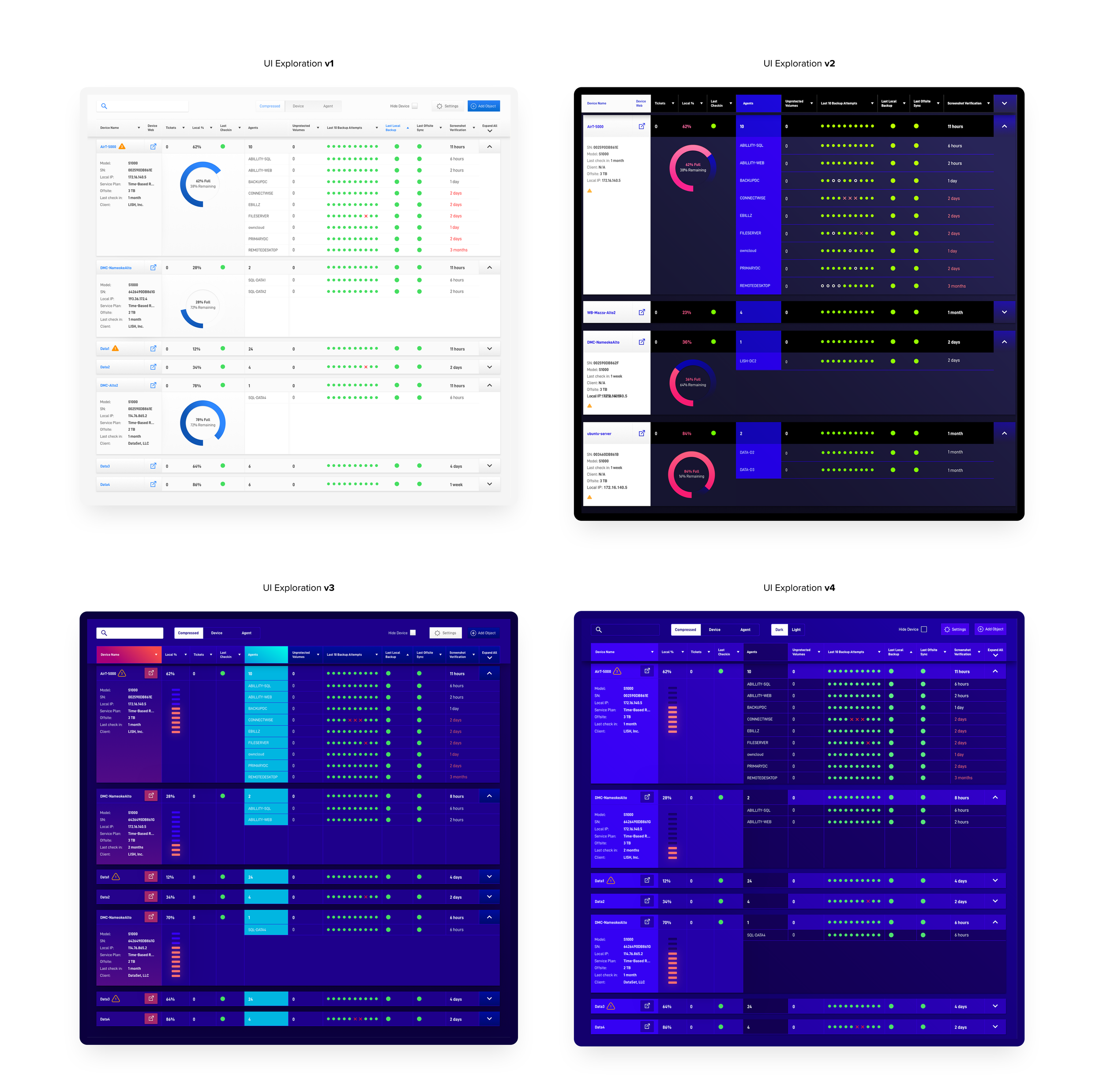
Phase 1 — Legacy baseline analysis
The original interface optimized for information density but not operational cognition.
Key observations:
critical conditions did not visually emerge
healthy and unhealthy states competed equally for attention
operators were forced into continuous active inspection
the interface behaved more like a database than a monitoring system
Phase 2 — Hierarchical grouping and segmentation
The second exploration introduced:
card-based grouping
subsystem segmentation
radial health summaries
improved spacing and hierarchy
This shifted the interaction model from:
row-by-row inspection
to:
grouped operational comprehension
The redesign improved scan efficiency and subsystem-level awareness while reducing visual parsing effort.
Phase 3 — Operational command interface
Later explorations introduced:
dark operational themes
stronger anomaly contrast
denser operational grouping
more aggressive hierarchy systems
The visual language intentionally moved closer to:
command centers
OT environments
cyber-physical monitoring systems
The interface increasingly supported:
peripheral anomaly recognition
rapid prioritization
escalation readiness
low-effort monitoring
The strongest concepts balanced high information density with clear operational hierarchy without returning to spreadsheet complexity.
Attention management
A major focus of the redesign was reducing attentional burden.
The original interface required operators to consciously inspect each system individually. The redesigned concepts instead emphasized:
anomaly emergence
grouped system summaries
reduced prominence of healthy states
rapid peripheral readability
The interface was intentionally designed so that:
healthy systems visually recede while degraded systems surface automatically.
This reduced vigilance fatigue and improved long-duration monitoring sustainability.
Alarm fatigue mitigation
Backup environments frequently generate large volumes of low-priority warnings.
The redesign explored ways to reduce alarm normalization through:
stronger severity differentiation
clearer degraded-state visibility
reduced emphasis on nominal states
escalation-oriented hierarchy
The interface avoided treating all statuses equally, helping operators reserve attention for meaningful operational events.
Physical ergonomics
The interface was evaluated for prolonged operational use.
Considerations included:
reduced eye movement
glance efficiency
readability at distance
low-light usability
sustained visual comfort
Dark-mode explorations specifically evaluated:
glare reduction
nighttime readability
reduced visual exhaustion
Spacing and grouping systems were refined to reduce visual compression while maintaining operational density.
Safety implications
While backup systems are not traditionally categorized as safety-critical interfaces, failures can still produce severe operational consequences, including:
unrecoverable data loss
failed disaster recovery
prolonged outages
regulatory non-compliance
business continuity failures
The redesign therefore emphasized:
anomaly visibility
degradation awareness
escalation clarity
operator confidence
to reduce the likelihood of unnoticed failures or delayed intervention.
Outcome
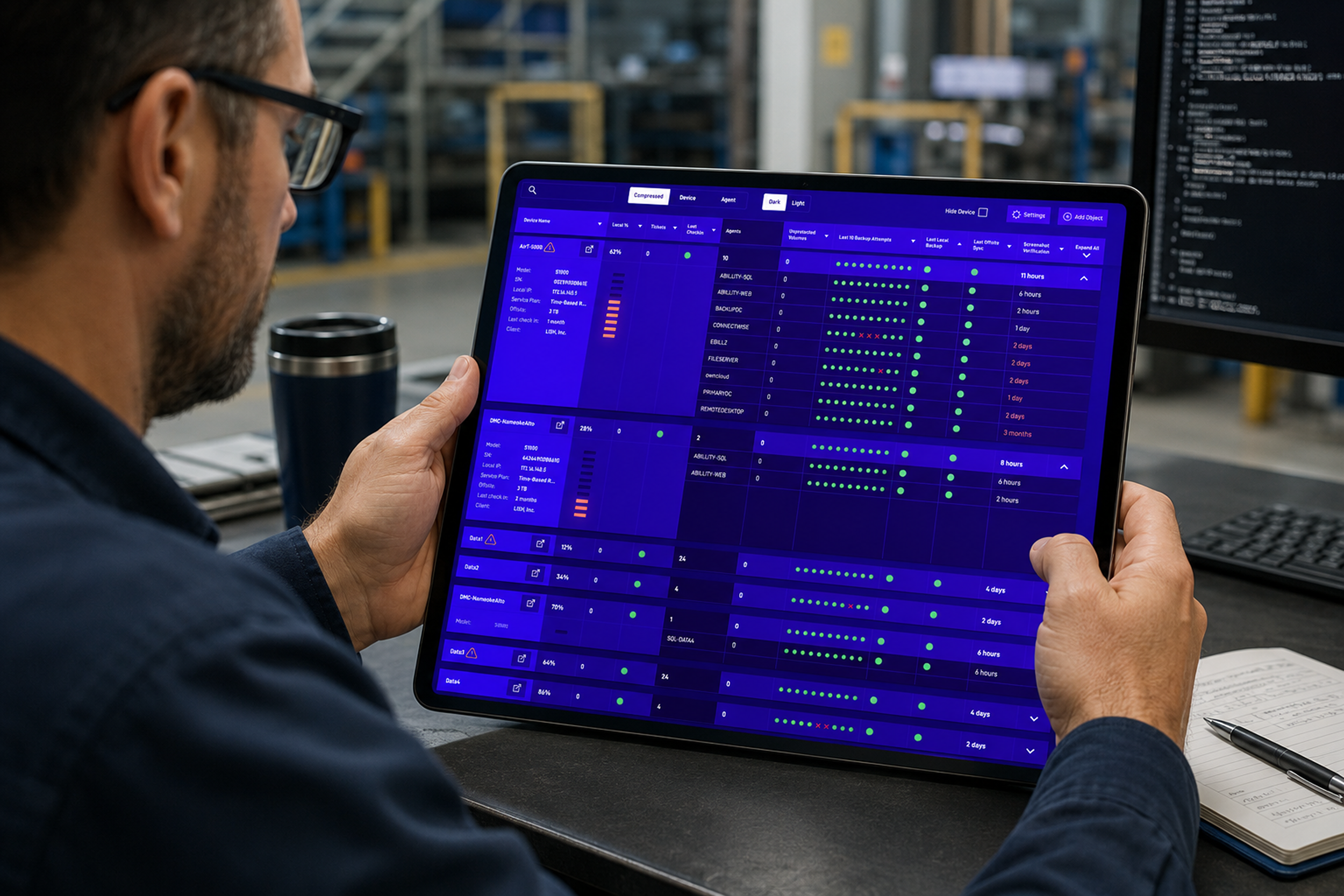
The final concepts demonstrated how human-centered operational design principles can substantially improve enterprise infrastructure tooling without sacrificing information density.
The redesigned platform improved:
scanability
anomaly visibility
subsystem awareness
operational hierarchy
cognitive sustainability
perceived system trust